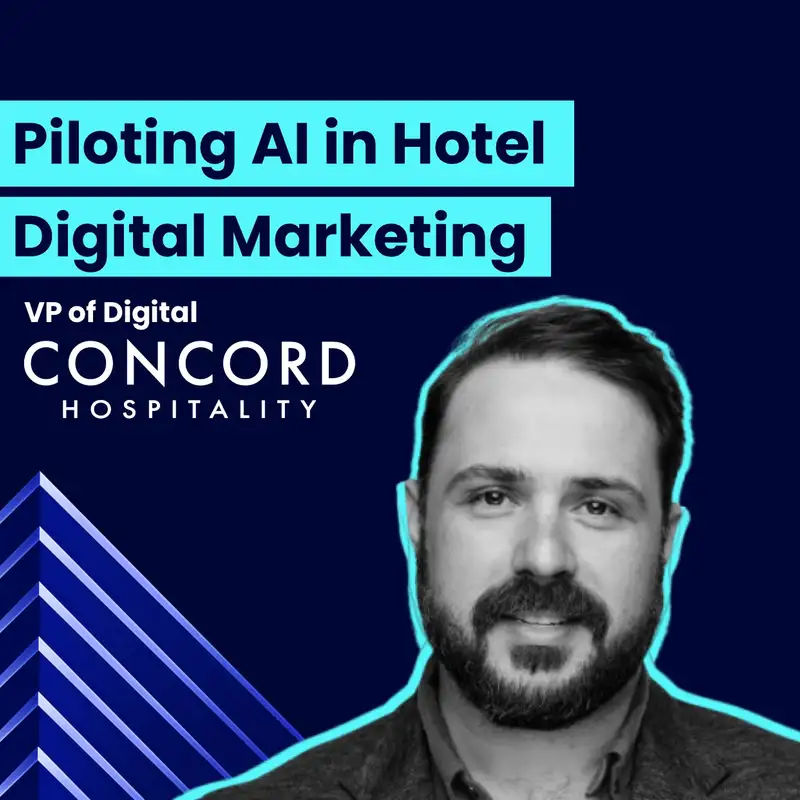
Concord VP on Piloting AI in Hotel Marketing
This episode is part of a series created in partnership with Forge (Questex) and The Hospitality Show Miami where Dan will be speaking on November 2nd.
What happens when a hotel management company stops treating AI as a side project and starts building it into the operating model?
In this episode, Dan Fernandez, VP of Digital Marketing at Concord Hospitality, shares how one of North America’s largest third-party hotel operators is approaching AI, digital marketing, and technology adoption across more than 150 hotels and 50 restaurants. Rather than chasing every new tool, Concord has built a structured AI steering committee, created field-level feedback loops, and adopted a disciplined approach to running focused 90-day pilots before scaling what works.
For experienced hoteliers, the conversation goes beyond generic AI predictions and gets into what is actually changing inside hotel operations and commercial strategy today.
In the episode we discuss:
• Build an AI operating model, not just an AI toolkit. Learn how Concord structures its AI steering committee, field committee, and training efforts so GMs, sales leaders, F&B teams, finance, and corporate executives can identify practical use cases without overwhelming hotel teams with more software.
• Pilot narrowly, then scale aggressively. Concord typically tests two AI initiatives at a time over roughly 90 days. Dan explains how that approach helped validate an AI voice agent at a large resort receiving hundreds or thousands of calls across the hotel, spa, golf, marina, and F&B operations before expanding it more broadly.
• Prepare for a major shift in hotel discovery. Dan explains why declining organic website traffic does not necessarily mean declining demand. AI is increasingly narrowing a traveler’s consideration set before they ever reach a hotel website, creating fewer visits but potentially higher-intent traffic. He also discusses how Concord is testing tools designed to improve hotel visibility and information accuracy across large
One of the more surprising insights from the conversation is that Dan believes the hotel marketing channel mix five years from now may look fundamentally different from today’s mix of paid search, social, SEO, email, and traditional distribution channels. His recommendation is less about predicting the winner and more about creating an organization that is constantly testing new channels early enough to learn before the rest of the market catches up.
The episode also covers the growing role of GEO and first-party hotel content in AI search, why soft brands are gaining strategic importance in upper-upscale and luxury development, how paid social is becoming more measurable as a revenue channel, and why hotel technology buyers may be undervaluing one of the least glamorous parts of vendor selection: post-sale customer service.
Dan brings an unusual perspective to the discussion. At Concord, he oversees digital marketing while also working across branding, social media, PR, and broader commercial functions, giving him visibility into both corporate strategy and what actually works at the property level. That operating perspective makes the episode especially useful for hoteliers trying to separate practical AI applications from vendor hype.
Subscribe to Hotel Tech Insider for more conversations with hotel executives testing new technology, commercial strategies, and operating models across the industry.
What happens when a hotel management company stops treating AI as a side project and starts building it into the operating model?
In this episode, Dan Fernandez, VP of Digital Marketing at Concord Hospitality, shares how one of North America’s largest third-party hotel operators is approaching AI, digital marketing, and technology adoption across more than 150 hotels and 50 restaurants. Rather than chasing every new tool, Concord has built a structured AI steering committee, created field-level feedback loops, and adopted a disciplined approach to running focused 90-day pilots before scaling what works.
For experienced hoteliers, the conversation goes beyond generic AI predictions and gets into what is actually changing inside hotel operations and commercial strategy today.
In the episode we discuss:
• Build an AI operating model, not just an AI toolkit. Learn how Concord structures its AI steering committee, field committee, and training efforts so GMs, sales leaders, F&B teams, finance, and corporate executives can identify practical use cases without overwhelming hotel teams with more software.
• Pilot narrowly, then scale aggressively. Concord typically tests two AI initiatives at a time over roughly 90 days. Dan explains how that approach helped validate an AI voice agent at a large resort receiving hundreds or thousands of calls across the hotel, spa, golf, marina, and F&B operations before expanding it more broadly.
• Prepare for a major shift in hotel discovery. Dan explains why declining organic website traffic does not necessarily mean declining demand. AI is increasingly narrowing a traveler’s consideration set before they ever reach a hotel website, creating fewer visits but potentially higher-intent traffic. He also discusses how Concord is testing tools designed to improve hotel visibility and information accuracy across large
One of the more surprising insights from the conversation is that Dan believes the hotel marketing channel mix five years from now may look fundamentally different from today’s mix of paid search, social, SEO, email, and traditional distribution channels. His recommendation is less about predicting the winner and more about creating an organization that is constantly testing new channels early enough to learn before the rest of the market catches up.
The episode also covers the growing role of GEO and first-party hotel content in AI search, why soft brands are gaining strategic importance in upper-upscale and luxury development, how paid social is becoming more measurable as a revenue channel, and why hotel technology buyers may be undervaluing one of the least glamorous parts of vendor selection: post-sale customer service.
Dan brings an unusual perspective to the discussion. At Concord, he oversees digital marketing while also working across branding, social media, PR, and broader commercial functions, giving him visibility into both corporate strategy and what actually works at the property level. That operating perspective makes the episode especially useful for hoteliers trying to separate practical AI applications from vendor hype.
Subscribe to Hotel Tech Insider for more conversations with hotel executives testing new technology, commercial strategies, and operating models across the industry.