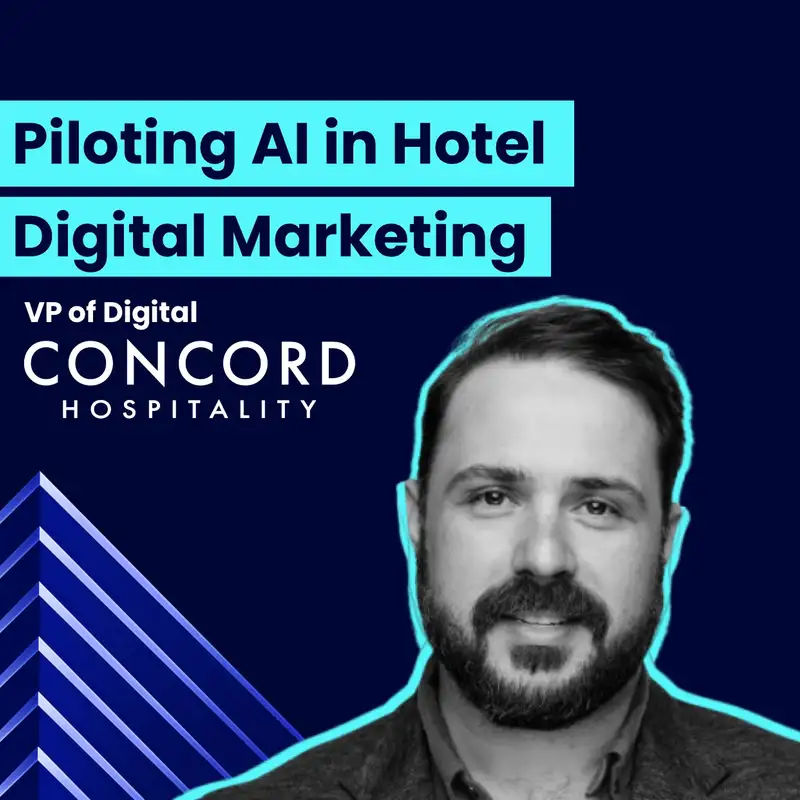
Concord VP on Piloting AI in Hotel Marketing
I think the media channel mix and what us as marketers have as our foundational media channels today, I think that looks very different in five years.
Speaker 2:From Hotel Tech Report, it's Hotel Tech Insider, a show about the future of hotels and the technology that powers them. Today on the show, we have Dan Fernandez, VP of digital marketing at Concord Hospitality, which operates more than a 150 hotels across North America. This episode is a part of a special series we're doing in partnership with the Hospitality Show in Miami this November, which we encourage our entire audience to go check out. Dan will be speaking there alongside some of the biggest names in the industry, like Hilton CEO Chris Messetta. And obviously, it's in Miami in November.
Speaker 2:Who wouldn't wanna go? In this episode, we get into what Concorde is actually doing today with AI, what's working, what they're testing, and where Dan thinks hotel marketing is headed next. Dan, thanks so much for coming on the show today. We're stoked to have you. I always love to start with just a quick overview of your company, Concord Hospitality, and your role within the organization.
Speaker 2:Let's kick things off.
Speaker 1:Absolutely. So Dan Fernandez is vice president of digital marketing for Concord. I oversee the digital marketing team, also heavily involved in all things branding and social media and PR and a lot of those different commercial functions as well. Concord Hospitality, third party management company, over 150 hotels, over 50 restaurants across North America. Been in the industry for forty years, really operating across all different hotel segments, whether that's branded, independent, luxury, lifestyle, experiential properties.
Speaker 1:Yeah. And excited to be here, Jordan. Thank you. Awesome. And are you
Speaker 2:guys all US based hotels?
Speaker 1:A majority are in The US, and we're in 26 states, but we're also in Canada.
Speaker 2:Obviously, the digital marketing space, if you look at like five years ago to today, pre ChatGPT three or whatever it was in 2022, I think distribution has changed. People have said OTAs are going to die. Other people say OTAs are going to dominate. What would you say looking back five years to today are some of the biggest changes in digital marketing in terms of like your channel mix, ad platform effectiveness? Where are the biggest changes that you've seen in the last five years since the advent of mass market LLMs?
Speaker 1:Yeah, that's a great question. You know, I don't know that the channel mix, especially the distribution between like direct and brand.com and OTA has made a massive shift. I think for the most part, that's actually fade, Maybe it's because there's been kind of an arms race on both sides that has kind of kept them both fairly stable in that. I do think that the OTAs have probably been quicker to innovate AI within some of their platforms than brands have. So there might be a slight advantage leading toward some of the exposure within some of the kind of new distribution tools, whether it is just how consumers are using AI to search or Gentec AI toward the OTAs.
Speaker 1:But I think the brands understand the risks there and are playing catch up pretty quick.
Speaker 2:And working with multiple brands, are you seeing material differences in terms of how the brands are either performing or executing in terms of the deliverables to you guys of web traffic? Are certain brands like ahead of the curve on GEO versus paid? Or do you kind of view them as somewhat of a commodity in the digital marketing space when you're selecting a flag for your new property?
Speaker 1:Some are certainly ahead of others. I'd say Marriott's one that's actually done a very good job of being proactive in that space, as well as frankly listening to their franchise partners and to the management company partners and making some real change based on feedback from those of us that are kind of pounding that drum, so to speak. And one thing that I also think they are doing very well on, and I see some innovation there, is giving that kind of AI data back into the operator's hands. Whether it is, hey, the top prompts that we're seeing or web traffic distribution from different AI systems.
Speaker 2:And are you guys still working with a third party digital agency? I know you come from the world at Sendai and the services division. Are your branded properties, are they mostly relying on the chain marketing teams, digital marketing teams? Or are you also employing third party agencies like a Sendine or ScreenPilot or someone like that?
Speaker 1:That's a good question. We don't rely just on the brand field marketing and marketing services. They have great internal teams. But we actually do a lot of it in house. So we have an internal digital marketing team that essentially acts as the digital marketing agency for Concord.
Speaker 1:So we have a team of digital marketing experts that each oversee a subset of our hotels and really acts as the digital lead. And they're doing a lot in house themselves, things like media optimization and management, SEO, and geo. And so a lot of that, we actually historically have not relied upon third party agencies for that core. Now that said, we do use agency partners for things like social media and PR and web development. So, we've kind of done a bit of a hybrid mix of, hey, what can we do internally?
Speaker 1:And kind of develop whether it's proprietary workflows around or just do things where we feel like we can be a little bit closer to the hotel teams to help execute strategy, while also hiring experts where we are realistic and say, hey, you know what? We think we could hire a partner that has best in class technology and best in class people and can be a partner with us to execute that.
Speaker 2:You mentioned before our call that a big part of your pipeline is soft brands. What's going on there? Is that this concept of brand saturation in South Beach? And so we're not going to put a new thirty fifth Hilton brand there. We're gonna do a soft brand and that way we could still grow our flags in that area.
Speaker 2:Is that kind of the reason why you're seeing that? Or what are the dynamics that you're seeing in the digital marketing world as well that play into that?
Speaker 1:Yeah, you know, I think some of the more economics of around that is most of our soft brands are in the upper upscale lifestyle luxury space. And it's, you know, the K shaped economy, I think everyone kind of knows that term now and the growth in that segment. So I think that's part of just the organic reason why that pipeline is growing is the financial viability of that space. But also like soft brands, it's the best of both worlds. You have essentially an independent brand concept that if done and marketed well, and that branding is done really well, is an added value to that asset.
Speaker 1:It helps actually grow the valuation of that asset, whether it's encumbered to a brand or not, because you're really building a lot of the consumer loyalty, not to the flag necessarily, but to the actual soft independent brand of that hotel, while also having the backing of a loyalty program that has 300,000,000 people. And so that's super powerful. I also think a lot of consumers these days, they want to stay somewhere that is unique, that has unique interior design and unique F and B, and is not the same as every other X brand that is in another market.
Speaker 2:Yeah, consistency is no longer an asset because quality is kind of expected with online reviews and TripAdvisor and everything.
Speaker 1:Yeah, exactly. And so, I think it's a great differentiator in that. And that's one of the areas that I love working with branding agencies. There's a lot of brilliant ones out there. And that crafting of a brand from the ground up, and then seeing it come to life is one of my favorite things that I do here.
Speaker 2:SEO world has changed a lot. Are there big changes that you're seeing in terms of website traffic? Software companies are seeing a lot of traffic fall off a cliff, but the traffic that's coming in is more converting at a higher rate and sometimes higher value because they're more researched customers. Is there any major trends you've seen the last couple of years on the Google SEO side of things?
Speaker 1:Well, I think we're definitely seeing that as well. There's certainly a lot more kind of what's called zero click interactions with content that affects a good bit of that as well. But we have seen that, and especially in some markets, either kind of flattening or a dip in traffic, and then a rise in conversion rates or a rise in what we consider a more relevant audience that is visiting the website or a higher converting audience. I think part of that is partly I think AI has done a great job of distilling someone's research down a lot more in that where previously I don't have the exact anecdotal evidence of this, but where somebody in the past, maybe they visited 10 to 15 hotels as part of their research process to figure out their consideration set. Now, they're using AI to accelerate that.
Speaker 1:And they're considering three to four hotels instead of instead of visiting 10, they're now visiting four and they're more relevant because they're a little bit further down in the funnel and there's less of a consideration set there. I think a lot of that is impacting some of the website traffic as well.
Speaker 2:So social paid with Meta and Trauma, TikTok, any major kind of movements there that you're seeing?
Speaker 1:On that side, I would say it's a more relevant audience than it used to be that we're seeing from paid social. Where historically, you would do paid social. You know if you ever did mix mixed media modeling, social was always one of those channels that performed very well from an attribution standpoint. But if you looked at it isolated with return on ad spend, did not look good. Paid search, at least non brand paid search kind of fell in that bucket too.
Speaker 1:We're seeing increases in revenue through social channels, which is fantastic because it helps make it a little easier to justify an investment there to an owner where we've always known it's important. So that's made that a little bit easier.
Speaker 2:Before we started, you were telling me a little bit about the AI Committee over at Concord. Obviously, think every hotel group is going through this right now. How do we reorg around this new technology? It kind of touches every single department. Can you tell me about your journey internally at Concord of building that committee?
Speaker 2:What does it mean? What is the structure? And what's your mandate? And then we can talk about some of the pilots and other stuff that you guys are working on.
Speaker 1:Yep. So, we have our kind of AI steering committee that we put together about three years ago. Yeah, I'd say about three years ago. It is chaired by myself and our Chief Technology Officer, Brian Cornell. And started off as a pretty small group of just, okay, how do we get our arms around this?
Speaker 1:What governance do we need to put in place? Guardrails? What large language model do we ultimately want to move forward with from an enterprise standpoint? We're getting every day hotels and owners throwing different products thrown at us. How do we put together kind of an assessment process for that to determine what's worth really looking at and taking the next step and putting out a proposal and who to meet with.
Speaker 1:So we have our overarching steering committee. We also have two subcommittees. One of them is a field, we call it our AI fields committee. And that is made up of GMs, directors of sales, F and B leaders, HR leaders, finance leaders from out in the field. And the main goal of that committee has really been, how do we get AI in the hands of the folks actually operating the properties and boots on the ground and learn from them?
Speaker 1:Learn how they're using it. Because it's really easy for us from a corporate standpoint to be like, hey, this is how a GM should be. This is how a director of sales should be using AI. It's a very different world getting it in their hands, and then telling us, hey, this is where I think I can get some efficiencies with. And here's some things that maybe from the corporate side, we're not thinking of.
Speaker 1:So that committee has been actually incredible at us being able to do that and really listen to all of our leaders in the field and how they're using it. And then we have another subcommittee that's essentially kind of a training, an LMS style committee. AI is very intimidating for a lot of folks that traditionally either aren't overly tech savvy or for the most part engaging with guests face to face every day, but maybe aren't in front of their computers, testing out ChatGPT and Copilot and Gemini and Claudine.
Speaker 2:Don't want to debug for six hours after work either.
Speaker 1:Exactly. And we did an associate engagement survey the earlier part of this year. One of the feedback points that came back was, hey, there is just it's app overload. There is you have a different app for your P and L management, and for your clock in and personnel management software, and for your marketing team, and for your sales team, and consolidation of that. And we were, so we were very sensitive too of, okay, how do we help from the AI standpoint?
Speaker 1:We know this is important. We know that we have to train our people on how to leverage AI, whether it's tools that they develop themselves, tools that we develop from corporate or partners that we work with. And so that committee is really dedicated on taking all of the learnings from across the company of how people are using it, how can it be ingrained in different workflows, developing new tools and apps with it, and then rolling it out to the field in a way that is not overwhelming. And then also, frankly, just leveling up the basic, I say, education level of all of our associates with AI, how to do the basics.
Speaker 2:So I know you guys are a Microsoft co pilot shop and that you've also done some work not just on the sales CRM emailing side, but also on the voice side with Blue IP. Can you talk about that? How you guys use Blue IP? Where it sits within your call center slash front desk ecosystem and how that's been going for you?
Speaker 1:Yeah, absolutely. So on that side, kind of pulling it back just slightly, you know, we're careful not to bite off more than we can chew. And so we kind of have this internal philosophy. We always wanna be piloting something on the AI front. And what we've really found is, hey, let's pilot two things at a time.
Speaker 1:Let's try to do it over ninety days, and then move on to the next two pilots and the next two. And really figure out, hey, can we scale this out? Two recently successful ones that we're scaling out. One of them is with Blue IP, you mentioned, which we tested at a couple resorts. One of them is a 200 acre oceanfront branded resort that has golf and a marina and spa, and, you know, that gets hundreds, if not thousands of phone calls a day across a variety of different departments, whether it's the golf club or again, the marina, the spa, the hotel, the four or five F and B restaurants that it has, and using an AI answering agent to, one, hopefully just answer the questions that are coming through quickly.
Speaker 1:So that our front desk agents and our concierge and our folks can engage with the person that's in front of them without having the phone ringing to the side. And then in the case that it can't answer the questions, making sure that it's diverting it to the right department that ultimately can. Wildly successful in that. We will be scaling that out across our hotels.
Speaker 2:I know you mentioned one other AI pilot around GEO visibility. Do you wanna talk about where that came from? I know it was a friend involved in the business and that friend was I think the podcast episode one or two's guest on this show. Could you talk a little bit about Bonafide and how you guys are piloting them and what the goals are there?
Speaker 1:Yeah. So we're still really early with that pilot. The old mentor, Tim Sullivan, I worked with at Sendai sits on their board and really sharp tool. And we get asked the question a lot of what can I do to both get my hotel to show up in AI to make sure that our content that is in AI is accurate, that it's talking about my hotel the way that is in our brand voice, that it should be communicated? And we're always looking at a number of AI tools.
Speaker 1:And this one kind of stood out both from the reporting platform is incredible. And also the fact that they integrate really well, not just independent properties, but with branded properties as well. And we have a lot of brand hotels. And a lot of times that brand's tech stack is pretty silent, and they keep that close. And this is one where, hey, we can do this for not just an independent hotel or an autograph, but also for a courtyard or a Hampton Inn.
Speaker 1:Anyway, so they create kind of a contextual packet of information for the hotel that's really built for the large language models. And I specifically like that because it helps point the large language models towards our first party content as the single point of truth. And that's something that the OTAs have done a very good job of with the nature of scale that they have and the amount of content that they have on their platforms of being the reference point for a lot of AI prompts. A lot of times you'll see the TripAdvisor's and Expedia's and Booking of the World being kind of the main reference point for data. And we want our first party content to do that.
Speaker 1:And this tool kind of helps that, while also helping make sure that the information out there about our hotels is accurate. So, if on one large language model, it's saying, Hey, this hotel's pet friendly, and the pet fee's $75 And this one is pulling from some old data where the pet fee was $50 This tool kind of helps synergize that and making sure that the information out there is accurate. It actually monitors that and gives you kind of a assessment score and an alignment score of if your information out there is accurate.
Speaker 2:Awesome. We've covered a lot of ground. One of the things I always like to ask, and if you need a minute, that's okay. What's one thing that you think everyone in the industry believes right now that you think is wrong?
Speaker 1:I think that especially in the B2B software realm, and it's not that everyone thinks that this is wrong, but I think it's undervalued. And that is, a lot of times, let's say you're assessing a technology partner or an agency on something. That kind of innovation and maybe product, super advanced product capabilities is the utmost importance. That, hey, we want to pick the partner that really just gives us the flashiest tool and the coolest dashboard. And I think it's very undervalued of B2B customer service.
Speaker 1:And really choosing a partner that can I mean, that can obviously provide great customer service, but doesn't kind of disappear once the contract is signed? You're kind of left on your own for implementation. And then all these fancy tools that you're given and kind of the shiny penny doesn't really get used because the team that then is ultimately responsible for utilizing it either isn't trained on it, or something breaks and it's a long lead time. You know, that customer service piece, I think, is a little bit undervalued and not always assessed within kind of the proposal process of kind of, Hey, what does that post signing support look like? And is this a company that we can really scale out with?
Speaker 1:And that if I have an issue, I can pick up the phone and call one of their senior leaders and actually get something moving. And for us, that's really important. We have scale. So a lot of times when we're kind of picking up a partner, we try to make sure that, hey, this is one where we can kind of influence some of that. And not only influence that customer service side, but also influence the potential trajectory of the product.
Speaker 1:If there's something within the product that we say, Hey, it would be great if it had this solution or if the dashboard had these couple of elements added, working with a partner where they're kind of malleable to some of that feedback.
Speaker 2:Awesome. Well, anything else that you think is a huge tectonic shift in hospitality, hotel tech, marketing that we haven't touched on today?
Speaker 1:I think the media landscape on the digital side is gonna change a lot. I think that you're traditionally in, you even look at it, hey, where you were ten, fifteen years ago, where it was all display advertising and email marketing, paid search, meta kind of worked its way in and paid social became more influential and influencers and content creators, you know, became, I think, the media channel mix and what us as marketers have as our foundational media channels today. I think that looks very different in five years.
Speaker 2:For sure. Just gotta always be piloting and trying the new stuff. And when the new stuff comes that works, you're ahead of the curve.
Speaker 1:That's right. Try to be at the front of the pack.
Speaker 2:Awesome, Dan. Well, thanks so much for your time today. This has been an awesome conversation.
Speaker 1:I appreciate it. Thanks, Jordan.
Speaker 2:That's all for today's episode. Thanks for listening to Hotel Tech Insider produced by hoteltechreport dot com. Our goal with this podcast is to show you how the best in the business are leveraging technology to grow their properties and outperform the concept by using innovative digital tools and strategies. I encourage all of our listeners to go try at least one of these strategies or tools that you learned from today's episode. Successful digital transformation is all about consistent small experiments over a long period of time, so don't wait until tomorrow to try something new.
Speaker 2:Do you know a hotelier who would be great to feature on this show, or do you think that your story would bring a lot of value to our audience? Reach out to me directly on LinkedIn by searching for Jordan Hollander. For more episodes like this, follow Hotel Tech Insider on all major streaming platforms like Spotify and Apple Music.